
Using StimmunoGuard to improve animal health
Rearing conditions and growth rates of farmed animals are different to those found in the wild. Two important differences are the stocking densities and the focus on faster growth. Both could generate stressful conditions that can affect animals' health and their ability to deal with challenges. That is why it is important to provide animals with extra support for their overall health. One way is by using immune modulators, such as beta-glucans, which help regulate and enhance the animal’s immune system.

By supporting the immune response, these feed additives can help animals better resist infections, reduce the impact of stress, and improve overall performance. This is especially valuable in intensive farming systems, where animals are exposed to various stressors and pathogens.
Among the most commonly used immune modulators are beta-glucans, which are available in a wide variety. In general, yeast-based beta-glucans are the most commonly used. In addition to these products, Koudijs now offers fungal beta-glucans called StimmunoGuard.
Beta-glucans and chitin are active components which are recognized as Pathogen Associated Molecular Patterns (PAMPs), meaning that immune cells associate them as pathogens. This leads to a series of actions, making immune cells more alert to real challenges. When applied correctly, these components allow the animal’s immune system to react faster when needed.
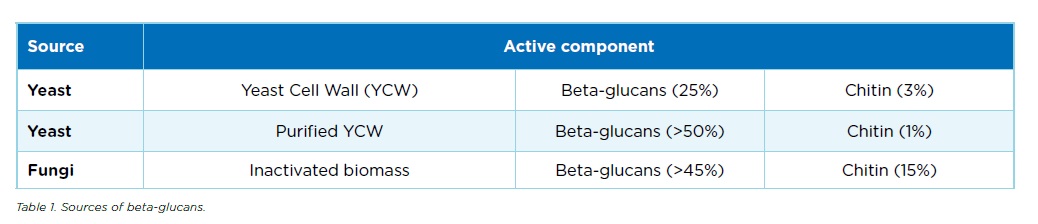
Yeast cell wall beta-glucans, generally come from either baker’s yeast or brewer’s yeast (saccharomyces cerevisiae). Depending on the substrate, stressors during the fermentation process, and selection, the number of betaglucans vary in yeast cell walls. Through various steps, yeastbased beta-glucans can be purified to reach concentrations of 50% or higher. This process is very costly, which is partially compensated by lower inclusion rates.
Fungi (Aspergillus niger) have a significantly higher concentration of both beta-glucans and chitin. Chitin acts in a similar way to beta-glucans by being recognised as PAMPs.
Another source of beta-glucans is cereal grains (e.g., oats and barley). However, these have a different molecular structure that has little to no interaction with receptors on immune cells, but can have a benefit as a prebiotic.
How do beta-glucans and chitin communicate with immune cells?
For immune cells to work properly, they need to be able to recognize microorganisms that are not normally found in the body and mount a corresponding response. This happens first through recognition of molecular patterns that are specific to these, usually pathogenic, microorganisms. These molecular patterns are called PAMPs and are recognized by pathogen recognition receptors (PRRs) located on the membranes of immune cells, such as macrophages, dendritic cells, or neutrophil granulocytes. Beta-glucans and chitin are seen as PAMPs and therefore can bind to PRRs such as TLRs (Toll-like Receptors) and CLRs (C-type Lectin Receptors) on immune
cells. After binding to a receptor, a response is triggered, which can enhance phagocytic activity, production of anti-microbial compounds (e.g., reactive oxygen species (ROS), lysozyme, and nitric oxide (NO) production), and/or cytokine release that can further enhance communication between immune cells. This series of reactions can eventually result in an enhanced immune response to different challenges. In effect, beta-glucans train or prime the immune system to deal with stress and tackle potential pathogens, without killing them directly. StimmunoGuard is such a product, rich in both betaglucans and chitin originating from fungi. Various trials have been conducted, of which we will highlight an in-vitro and an in-vivo trial.
How to prove the effect?
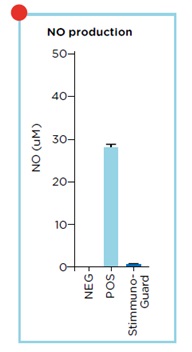
An in-vitro trial in collaboration with Wageningen University (WUR) was conducted to test the effect of StimmunoGuard on chicken macrophage cell lines. The trial consisted of two parts: 1) Can StimmunoGuard influence the production of nitric oxide (NO) as an antimicrobial defence mechanism, and 2). Can StimmunoGuard influence the phagocytic activity of macrophages?
In part 1, macrophages were added to a well plate. The macrophages received 3 different treatments: a negative control treatment, a positive control treatment receiving a known stimulating agent (LPS), and a treatment receiving StimmunoGuard. Release of NO can be measured by adding a reagent that turns darker purple according to the amount of NO produced. The positive control had a very strong reaction, producing a lot of NO. StimmunoGuard had a smaller effect but is considered a positive effect and interpreted as priming of the macrophages.
In part 2, macrophages were again added to a well plate. Fluorescent labelled beadlets were added to the medium, which were recognised as a foreign substance by receptors on the macrophage, and then phagocytosed. The amount of phagocytosed beadlets was detected as a measure of the phagocytic activity of the macrophages. The first figure shows the result of phagocytic activity in this test for the negative control treatment (no additions), the control with the solvent, and StimmunoGuard.
StimmunoGuard treated macrophages showed very good phagocytosis of presented beadlets.
However, it is important that the macrophages remain viable after being treated with betaglucans.
The second figure shows there were no differences between any of the treatment groups. This in-vitro trial suggests that when applied correctly, betaglucans from StimmunoGuard can prime macrophages to be ready for the production of NO, and the stimulation of the phagocytosis of foreign substances without having a negative effect on the viability of the macrophages.

Highlighting an in-vivo trial with broilers
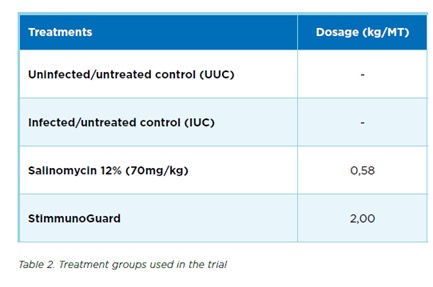
In Poulpharm, an experimental institute in Belgium, a total of 360 broilers were divided among 4 treatment groups according to Table 2, with 6 replicates per treatment, resulting in 15 birds per pen.
The birds were allowed to acclimatise from day 1 to day 12. Between day 12 and day 18, they all received a preventive antibiotic treatment. On day 19, 20, and 21, birds were orally infected with a bacterial challenge composed of E. coli, L. salivarius, L. crispatus, Enterococcus spp. and
C. perfringens. On day 20, an additional oral coccidial challenge was given (see Figure 1).
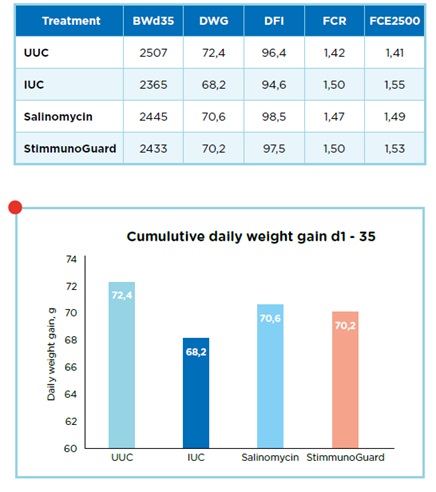
After 35 days, the IUC treatment group showed a significantly reduced final Body Weight (BW35) when compared to the UUC treatment group. Salinomycin and StimmunoGuard showed a numeric recovery in BW35 and daily weight gain (DWG) compared to the IUC treatment group. These results show that StimmunoGuard has a positive effect on broilers reared under challenging conditions.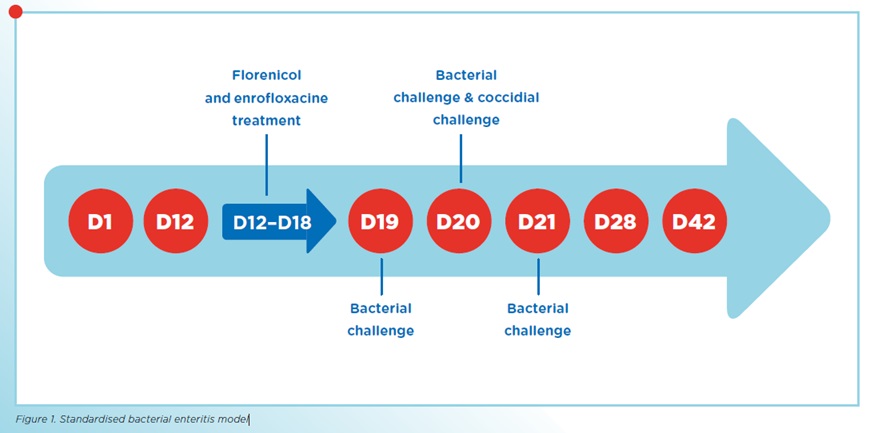
Conclusion
StimmunoGuard primes immune cells so that they are ready to act when there is a disease threat or a stress challenge without placing high demands on the vitality of these immune cells. Further trials with poultry, swine, and aquaculture have shown improvements in performance along with increased tolerance under environmental stress and pathogen challenge conditions. Good biosecurity and farm management are best for your farm, but when facing challenging conditions, we at Koudijs are ready to advise you on how StimmunoGuard can best be applied under your conditions. Contact your Koudijs representative for more information.
About the author

Maarten-Jay van Schoonhoven
Do you have any questions or would you like more information? Get in touch with Maarten Jay.