Do birds like what you offer? Why feed structure matters
Have you ever listened to feedback from your poultry as clients? And we mean that literally. From time to time, broiler farmers face lower feed intake at different stages of life. When this happens, feed is often the first thing questioned. Nutritionists may optimise feed daily, but nutritional mathematics, additives, and risk assessment of raw materials alone are no guarantee that birds will eat. Feed structure also matters. What birds are offered and when is crucial throughout their life. Physical characteristics of feed, shape, and structure significantly influence feed intake, digestion, and overall growth. Understanding these preferences helps optimise feed manufacturing and improve flock efficiency.

Why particle shape and size matter
Broilers are known to be selective feeders. However, research offers another perspective. Shivu et al. noted that broiler chickens are highly versatile when it comes to particle size variations. This is seen in a preference for larger particles than currently assumed, even at a very young age. This versatility is something we would like to explore further.
Birds will respond to taste and smell but will also consume more when feed is easy to pick up and swallow. As a result, the size, shape, and texture of feed particles are important. Having the right physical form ensures a higher feed intake.
In addition, an appropriate, coarser particle size supports digestive health and enhances gizzard development.
Preferred feed forms by growth stage
- Pre-starter and starter (0–14 days) phase
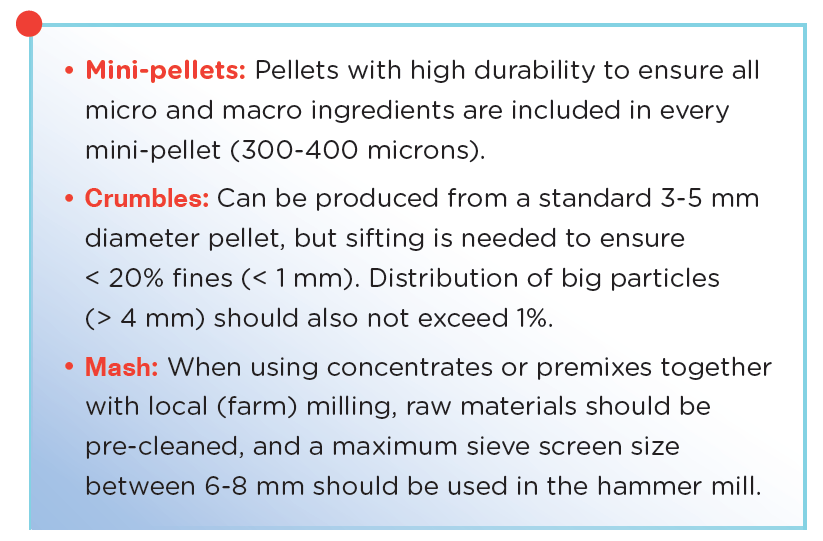
Small beaks of day-old chicks give them limited ability to handle larger particles. Therefore, a mini-pellet, crumble, or mash is preferred from day 0. However, we have to keep in mind that they develop quickly.
When feeding crumbles or mash to developing chicks, it has been shown that particle size and distribution of crumbles are important. The main conclusions from different research studies are:
- From 5 days of age, birds are able to eat bigger particles, e.g. > 3.5 mm.
- In a gender difference analysis, it was noted that female birds continue eating smaller particles for a longer time.
When crumbling in the plant, uniformity of particle size is really important. At this stage, excessive fines < 1 mm (> 20%) should be avoided, since this can reduce consumption and cause uneven growth. Post-sieving can prevent this issue.

3. Finisher phase (> 28 days)
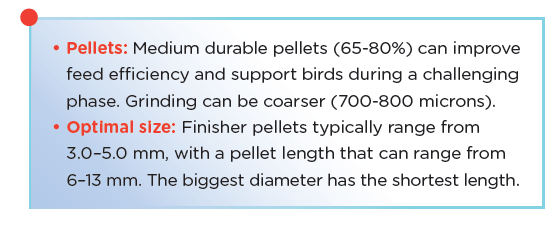
During the final growing period until thinning or harvesting, there are fewer challenges related to birds’ physical ability to consume pellets. Both literature and our own research show that birds can easily consume pellets ranging from 3.2 mm to 5 mm in diameter.
Due to the higher inclusion of fats, pellet durability is generally lower (Marumatsu et al., 2015). However, even lower-quality pellets do not negatively affect technical performance. In fact, this raises the question of whether perfectly durable pellets may lead to overeating or increased feed spillage at the feeder without providing additional performance benefits.
Including broken maize or whole wheat as part of the diet can provide gut health benefits (Ravindran et al., 2006) while also creating additional production capacity in the feed mill. These gut health improvements include enhanced gizzard development and a lower gizzard pH, which supports improved amino acid digestibility.
Production technology
From a production point of view, high pellet durability, generally between 85% and 90%, is desired. This reduces the risk of damage during handling and transport, resulting in fewer fines. Production processes such as heat treatment, moisture addition, fat inclusion in the mixture, and particle size together account for approximately 70% of the processing effect on pellet durability. The latest research and practical experience show that birds prefer softer pellets, which in production terms means lower durability (65–80%) rather than the traditionally desired 85–90%.
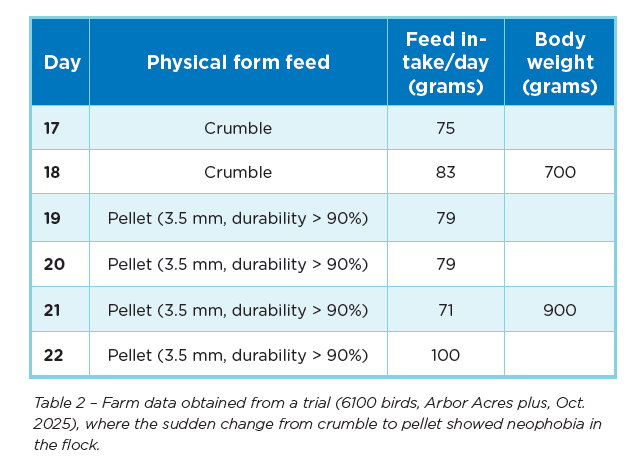
Pellets that are too hard (> 92%) can also lead to neophobia, feed spillage at the feeder due to selection, and reduced performance.
Too many fines can be addressed by:
- Coarser grinding of cereals:
Pellet durability and feed intake may be slightly lower, but there are no negative effects on production results at the farm level. In fact, the same or improved FCR is often recorded. - Adding raw materials with sticky properties:
Examples include fats such as soy or sunflower oil. - Reviewing the conditioning and pressing process:
This is unique to each production plant. Settings from one production plant cannot easily be transferred to another.
Key physical attributes of pellets
- Pellet durability
High durability (> 85–90%) minimises pellet breakage and fines from a production perspective. However, until birds reach 1 kg body weight, durability is less important than previously assumed. Keep fines (< 1 mm) to a maximum of 20% to reduce feed sorting and poor performance. - Particle size
Coarser grinding of raw materials at each phase, up to 700–800 microns, is beneficial for gizzard development (Taha et al., 2025). Coarser particles slow feed passage through the gizzard. Longer retention time supports a lower pH before feed enters the gut. This promotes protein digestibility and positively influences the microbiota, which can produce butyric acid. Both longer retention time and butyric acid production have been shown to improve growth efficiency. - Uniformity and appearance
Birds prefer a consistent shape and size. Irregular pellets or dusty feeds reduce intake. Review the crumbling process and determine whether a post-crumbling sieving step would improve quality.
Conclusion
Physical feed quality is as important as nutrient formulation. Birds can be trained to eat pellets, but they must be ready to make the transition. Keep in mind that most flocks are mixed sex, and recognise their ability to adapt to a more diverse range of feed forms. By aligning feed shape and size with bird preferences at each growth stage, producers can improve feed intake, enhance FCR, and maximise profitability.
It is truly worthwhile to get feedback from the poultry house.
Article references
- Kleyn (2013), Chicken Nutrition, A Guide for Nutritionists and Poultry Professionals, p. 4
- Marumatsu et al. (2015), Factors that Affect Pellet Quality: A Review, Journal of Agricultural Science and Technology A 5 (2015), 717–722
- Ravindran et al. (2006), Influence of Whole Wheat Feeding on the Development of Gastrointestinal Tract and Performance of Broiler Chickens, Australian Journal of Agricultural Research 57(1): 21–26
- Shivus et al. (2024), Effect of Wheat Coarseness and Pellet Quality on Performance and Particle Size Preference of Broiler Chickens Fed Diets Based on Wheat and Maize, Journal of Applied Poultry Research, Volume 33, Issue 3
- Taha et al. (2025), Optimizing Hammer Mill Speed: Impact on Growth Performance, Pellet Quality, and Gizzard Gene Expression in Broilers, Veterinary World, 2025, 2542–2552
Want to optimise your feed strategy?
About the author

Jos van Arkel
Poultry Specialist