
Replacing Choline Chloride with Betaine
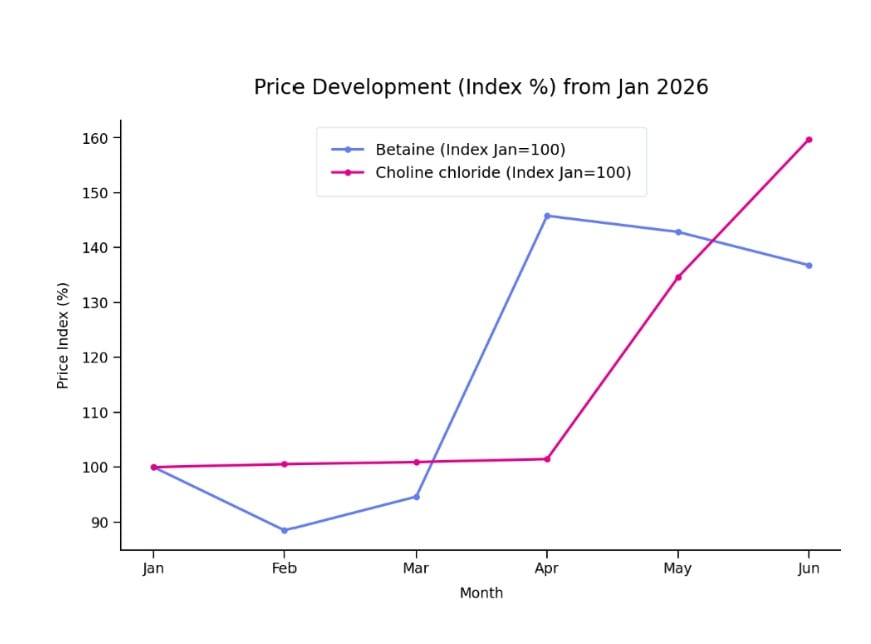
Developments in the petrochemical industry have significantly increased the price of choline chloride. As a result, the feed industry is continuously exploring more attractive alternatives. One potential option is the replacement of choline chloride with the cheaper betaine. The graph below illustrates the relative price development between betaine and choline chloride since the beginning of this year.

Replacing choline chloride may be interesting not only due to current market conditions, but also from a sustainability perspective, as betaine is derived from a natural origin. Most importantly, however, is the question of whether betaine can serve as a nutritional substitute, and to what extent choline chloride can be replaced.
Essential function of choline chloride
Choline chloride is a key nutrient in animal nutrition. Although it has several biological roles, from a practical feed formulation perspective two are truly relevant:
1. Liver fat metabolism (essential and not replaceable)
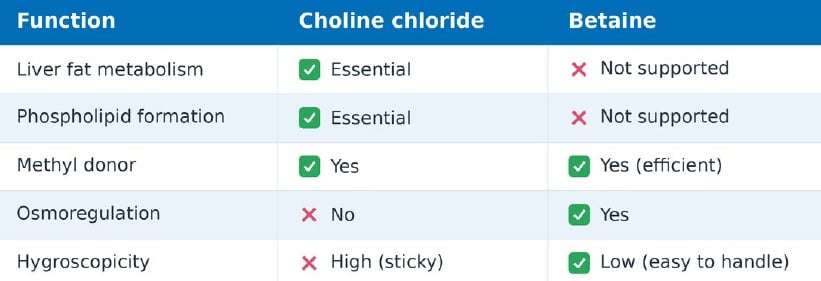
Choline chloride is a structural component of phosphatidylcholine, which is crucial for the formation of lipoproteins responsible for transporting fat out of the liver. This is especially important in modern, highly productive animals with high energy metabolism. As betaine cannot fulfil this structural role, this function of choline chloride cannot be replaced, and a minimum inclusion level remains necessary.
2. Methyl donor function (replaceable)
Choline chloride also acts as a methyl donor. In simple terms, methyl groups (CH₃) function as “switches” that activate essential metabolic processes, including the synthesis of methionine, creatine, and DNA components. This plays a key role in protein synthesis, growth performance, and feed efficiency. This function can be replaced by betaine.
Methyl groups can be supplied by choline chloride, betaine, or methionine. However, methionine should primarily be used for protein deposition, and its use as a methyl donor is economically less attractive, especially under current market conditions. Betaine is therefore the most efficient and practical alternative for this role.
Additional functions of betaine
In addition to being a methyl donor, betaine has several unique functions that choline chloride does not provide. The most important is its role as an osmolyte. Betaine helps regulate cell hydration, particularly under conditions of osmotic stress. This is highly relevant during heat stress or gut stress, such as after weaning or during infections. Furthermore, betaine is less hygroscopic than choline chloride, which makes it more favourable for premix quality and handling.
Conclusion
- A minimum level of choline chloride is essential and cannot be replaced. These minimum levels depend on the animal type and production stage.
- Betaine can fully replace the methyl donor function of choline chloride and offers additional functional benefits.
- A strategic combination of choline chloride and betaine is therefore recommended. Optimal inclusion and replacement levels depend on both the animal category and farm specific conditions, particularly in relation to potential stress factors.


