
OxiGuard, a practical solution to save costs in a volatile market
Due to the ongoing conflict in the Middle East, prices for key raw materials and energy are rising sharply. Because vitamin E production is closely linked to oil-derived inputs, this turbulence is directly driving vitamin E prices upward. With this newsflash, we want to highlight OxiGuard, our in house polyphenol product, as a practical and cost-effective solution. By partially replacing vitamin E, OxiGuard helps safeguard feed performance while reducing the impact of current market volatility.

Vitamin E a vital ingredient
Vitamin E plays an essential role in maintaining animal health and performance. It supports optimal muscle function, metabolic stability, DNA synthesis, fertility, and acts as a powerful antioxidant. By protecting cell membranes from oxidative damage, vitamin E helps animals cope with stressors such as heat, infection, high production pressure, or weaning.
Because livestock cannot synthesize vitamin E, they depend entirely on dietary supply. When availability is limited or prices rise sharply, as we are seeing now, the cost of premixes and complete feeds increases accordingly.
This makes smart supplementation strategies more important than ever. Polyphenol‑based antioxidants such as OxiGuard offer a reliable way to partially replace the antioxidant function* of vitamin E, helping to maintain feed performance and manage costs without compromising animal health or productivity.
OxiGuard our cost-effective solution
At Koudijs, we have carefully selected and tested the most effective polyphenols based on their antioxidative capacity. After three years of research, this resulted in a high-quality blend of natural polyphenols on a carrier, which we call OxiGuard. OxiGuard delivers antioxidant performance comparable to Vitamin E 50 on a 1‑to‑1 basis, making it a reliable alternative. To ensure consistent quality and proven efficacy, OxiGuard has been validated in multiple in vitro and in vivo experiments.
OxiGuard Validation
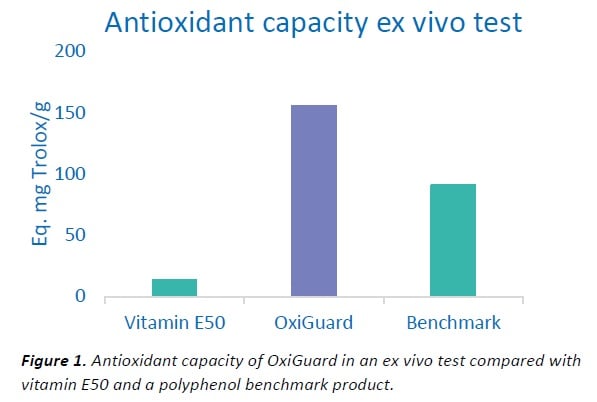
The effectiveness of OxiGuard was tested and validated in several studies. Below we present key validation results from our most important studies, demonstrating the proven antioxidant performance and reliability of OxiGuard. Figure 1 shows the antioxidant capacity of OxiGuard compared with vitamin E50 and a benchmark polyphenol product in an ex vivo red blood cell assay. In this test, red blood cells were stressed with light, and their half-life was measured and expressed in Trolox equivalents as the read-out parameter. A higher value indicates a better antioxidant capacity. The results demonstrate that OxiGuard outperformed both vitamin E50 and the benchmark product, indicating that OxiGuard provides a very strong antioxidant effect in this ex vivo model.
In Ross 308 broilers we evaluated whether 50% of the added vitamin E (at a low inclusion level of 30 mg/kg feed) could be replaced by OxiGuard.
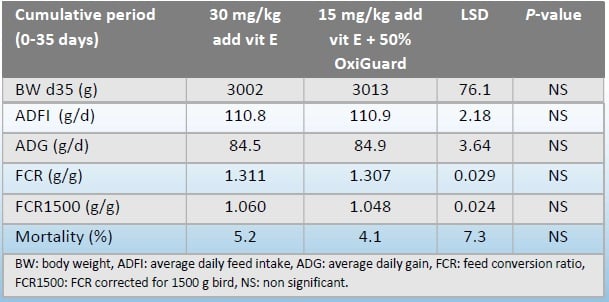
Table 1. Performance data of broilers fed a diet with 30 mg/kg added vitamin E versus a diet with 15 mg/kg vitamin E + 15 mg/kg vitamin E equivalent added in the form of OxiGuard.
The results shown in Table 1 indicate that this 50% replacement can be done with confidence, as no negative effects on broiler performance were observed. This demonstrates that even at a low vitamin E dosage, OxiGuard can successfully support antioxidant function without compromising growth.
Last year, OxiGuard was also evaluated in grower–finisher pigs. In this trial, 50% of the supplemental vitamin E was replaced by OxiGuard at two dietary vitamin E inclusion levels (30 mg/kg and 100 mg/kg added vitamin E). The results presented in Table 2 demonstrate that, regardless of the vitamin E dosage, replacing 50% of vitamin E with OxiGuard did not lead to any negative effects on animal performance or health parameters.
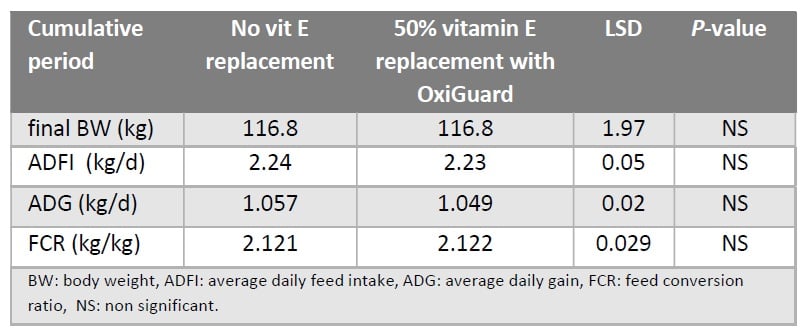
Table 2. Performance data of grower finisher pigs fed a diet with 30 mg/kg added vitamin E versus a diet with 15 mg/kg vitamin E + 15 mg/kg vitamin E equivalent added in the form of OxiGuard and fed a diet with 100 mg/kg added vitamin E versus a diets with 50 mg/kg vitamin E + 50 mg/kg vitamin E equivalent added in the form of OxiGuard. Results are presented as averages.
Based on the research conducted with OxiGuard, we have developed a vitamin E replacement recommendation tailored to each animal species and the specific life stage of the animals.
Do you want to know how much you can save?
We recommend reviewing your vitamin E premix levels and considering the use of OxiGuard to reduce costs. Our technical specialists are happy to review your situation with you.
*Note that only the antioxidant role of vitamin E can be replaced; a basal level of vitamin E is always required to support its other vital functions.
About the author

Yvonne van der Meer
International Product Manager Functional Ingredients
Do you have any questions or would you like more information? Get in touch with Yvonne.


