
What is really in every bite? The key role of homogeneous premixes
Homogeneity of premixes is one of the most important topics in premix formulation and production. It determines whether vitamins, trace elements and functional additives are delivered consistently to the animal. In practice, homogeneity is not only about mixer performance. It is the result of a series of nutritional, physical and technological decisions made long before production starts. Nutritional homogeneity requires an even distribution of micro-ingredients, as well as stability during transport, storage and dosing and minimal segregation during feed manufacturing. The starting point to achieving this is the choice of raw materials.

Particle size
Particle size of the raw materials is key when it comes to homogeneity in premixes. Large differences in particle size between ingredients increase the risk of segregation during mixing, transport and handling. Fine particles tend to sink, while coarse particles rise, leading to uneven distribution in the final product. This is also known as the Brazil nut effect.
Variation in size, form and weight
In addition to particle size, premix ingredients vary in specific weight and particle structure, from fine powder to coated beadlets or granules. This affects the way they mix with particles of other ingredients. As well as differences between ingredients, the particle size distribution within the ingredient can vary from a fine fraction to coarser particles.
Measurement is knowledge
Before a new raw material, or a raw material from a new supplier, is approved for use in our premix plant, it is reviewed by our quality control team. Particle size distribution is measured using a Camsizer, which replaces the traditional sieve-tower. In addition, flowability is tested and a visual assessment is performed. If necessary, a test mixture is made to get more insight into how a raw material behaves in a mixture.
Nutrient analysis in our laboratory can provide extra information about possible de-mixing. Intake control is of crucial importance for premix quality and safety. Every batch of raw material that enters the factory is tested by near-infrared (NIR) analysis before it is released, to make sure that there are no deviations in that batch of raw material. A visual control method is also used to guarantee consistent raw material quality.
As previously stated, a homogenous premix starts with the right choice of raw materials.

Overview of carriers
The carrier: the backbone of the premix
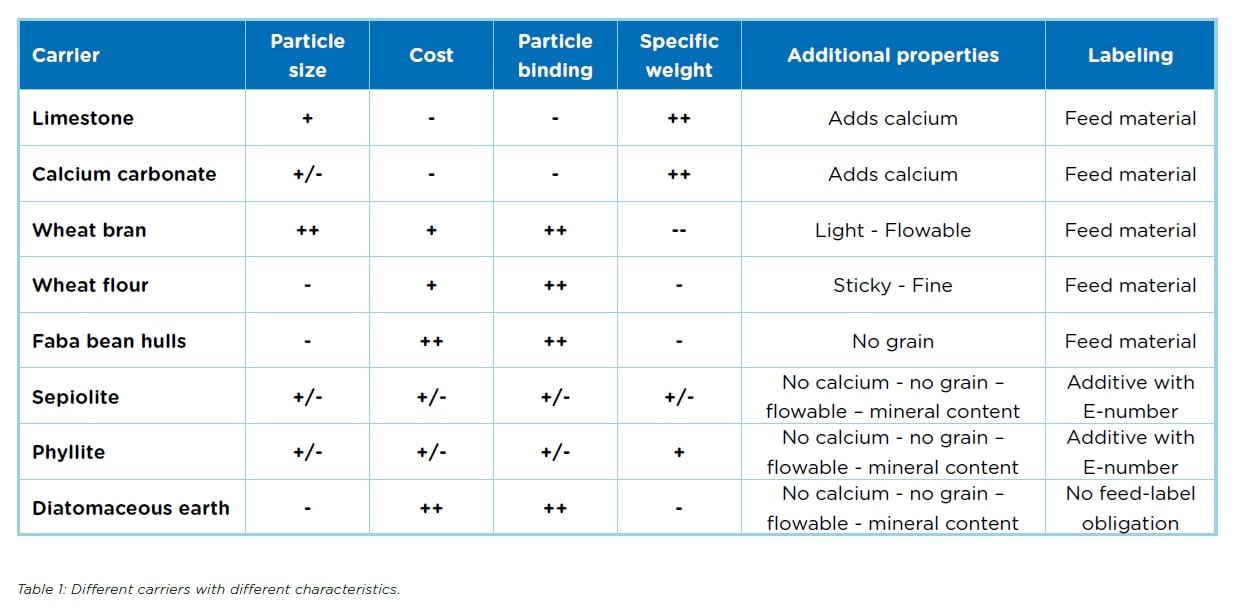
A very important ingredient in a premix is the carrier. The task of the carrier is to ensure that highly concentrated additives are evenly distributed in the premix and to prevent physical reactions between ingredients. Different carriers bring different properties, and there is no one-size-fits-all solution.
Limestone
Limestone and calcium carbonate are widely used for their stable quality and their low cost. In our premix plant, we use two different types of limestone: a fine and a coarser product, both with their own specifications regarding particle size. The fine limestone mixes well with ingredients with a small particle size, like powders. The coarser limestone covers the coarser ingredients in a premix, like small granules and beadlets.
Combining these two limestone carriers in a specific ratio enables us to formulate a homogenic premix.
Organic carriers
In addition to widely used limestone, we use organic carriers like wheat bran, wheat flour or milled faba bean hulls. These products have excellent particle binding properties and are therefore very suitable as a premix carrier. Wheat flour and wheat bran are commonly used in our premixes. Grain-free products like faba bean hulls are highly suitable for petfood premixes and concentrated pre-blends.
By purchasing high-quality, fine-milled products, particle size distribution is small and between-batch variations are minimal. By analysing our organic raw materials for moisture and toxins on a regular basis, we ensure consistent quality of the organic carriers.
Clay minerals
Clay minerals, like sepiolite, phyllite and diatomaceous earth, combine carrier functionality with specific technical properties. They are often used to improve flowability, reduce moisture-related issues and stabilize fine particles. These carriers can play a valuable role in complex premixes where physical stability is critical.
Chemical reactions
Premixes consist of highly concentrated ingredients. As a result, there is a high chance of physical reactions between ingredients, especially when working with choline and sulphates, known for their hygroscopicity. Moisture, pH and temperature can initiate chemical reactions within and between ingredients.
Coated particles like vitamins are sensitive to external influences, which may cause the coating to break, resulting in vitamin degradation. Lumps in a premix caused by moisture have a negative effect on the homogeneity of the premix. By leaving enough space for carriers in the recipe, and choosing suitable carriers, the risk of these chemical reactions is minimised.
Making the right choice
Selecting the right carrier depends on the application. The inclusion level of the premix, target species, packaging, feed mill equipment, climate, storage conditions and customer preferences all influence which carrier performs best.
Choosing a carrier should never be an afterthought. It deserves the same level of attention as nutrient selection and formulation strategy.

Quality control of end products
Besides intake control of raw materials, end products are analysed for nutritional value. Every batch of premix is sampled and analysis is done according to a fixed programme. This provides insight into the nutrient validation of our premix, but also into homogeneity.
A deviating analysis in a specific premix can be a reason to check the recipe for that product and adjust the carrier or the technical additives.
What can you do?
The quality of the final product depends not only on the mixing process, but on the entire downstream logistics chain. Whether transported in bags, big bags, or bulk trucks, each step — transport, handling, storage and dosing — carries a risk of de-mixing.
We are happy to work with you to safeguard homogeneity in your final product, ensuring nutritional value and functionality are maintained from factory to feed.
Producing a homogeneous premix is the result of multiple well-aligned decisions: a consistent particle size of raw materials, smart and physically balanced formulation, the supporting use of technical additives and the right carrier choice.
By paying attention to each of these elements, we can ensure consistent quality, reliable dosing and optimal animal performance. Batch after batch.
Want to learn more about premix homogeneity?
About the author

Evelien te Brinke
Premix Formulator


