The avian immune system - protecting the inside from the outside
The immune system is a complex network of cells, protein complexes, tissues, and mechanisms that protect an organism from harmful invaders. A well-functioning immune system is mandatory for good animal health and performance. In this article we describe the immune system in general, zoom in on the avian immune system and describe a nutritional solution to enhance the functioning of the immune system.

The immune system – a general outline
The immune system can be divided into two complimentary parts: 1) The innate immune system and 2) the adaptive immune system. Each has its own tasks in preventing harmful invaders from entering the body.
Innate immune system
The innate immune system is the first line of defence and is rapidly activated and non-specific. It responds quickly to all types of threats. Key components include:
- Physical barriers like the skin, intestinal lining, and lungs.
- Chemical barriers, for example a low (stomach) pH environment.
- Biological barriers, such as the microbiota in the gut.
- Soluble factors such as antimicrobial peptides, cytokines, chemokines etc.
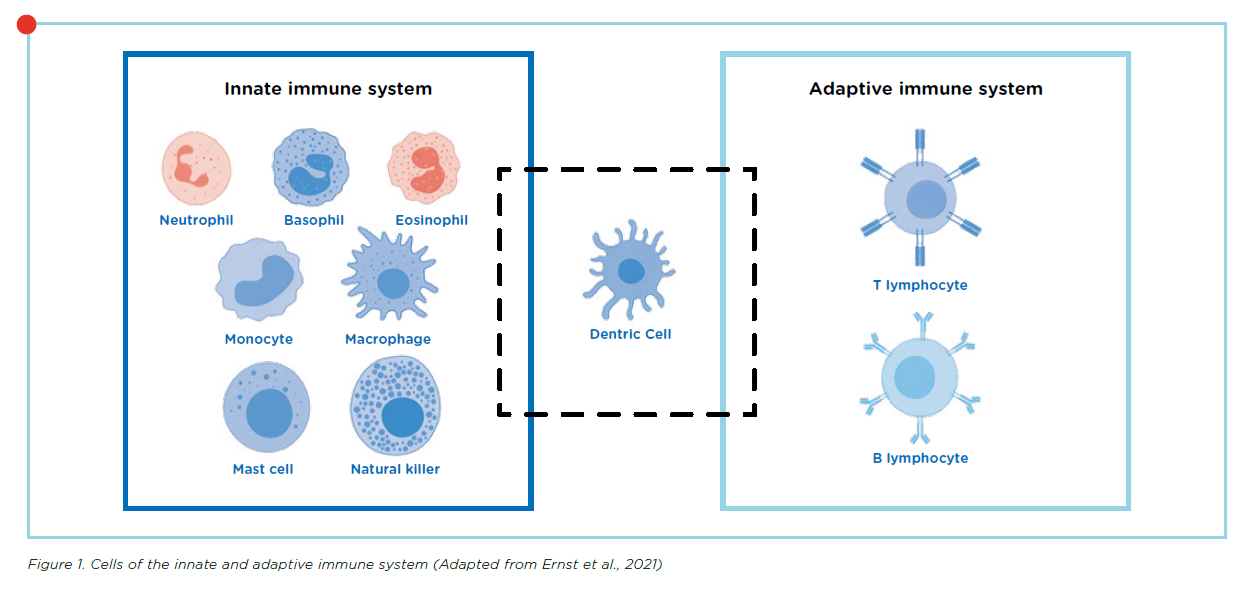
- Innate immune cells including macrophages, neutrophils, natural killer cells (NKC) and dendritic cells (Figure 1).
Adaptive immune system
The adaptive immune system needs time to be activated after a first encounter with a pathogen. Once activated, it gives highly specific and long-lasting immune protection, with a fast response and low energy requirements. The main drivers of the adaptive immune system are the T-lymphocytes and B-lymphocytes (Figure 1), with the latter responsible for producing antibodies such as IgM, IgA and IgG.
Avian immune system
The avian immune system shares the same core principles as the mammalian immune system but has unique adaptations. The avian immune system also consists of an innate and adaptive immune system, with some physiological differences. Birds have the bursa of Fabricius and lack lymph nodes, which are replaced by lymphoid tissue.
The lymphoid tissue is split into two categories (see above image):
- Primary lymphoid organs: the bursa of Fabricius and the thymus.
- Secondary lymphoid organs: the spleen and the mucosal associated lymphoid tissue (MALT).
The bursa of Fabricius specialises in humoral (macromolecule-mediated) immunity and is the place where lymphocytes mature. It is only active until 6 or 7 months of age, after which there is nearly no tissue left due to involution.
The thymus is responsible for the first line of defence. It generates cell-mediated immunity, which does not rely on the production of antibodies. This immunity is often accompanied by T-cell production and maturation, as well as the secretion of pro-inflammatory cytokines, which results in high nutritional requirements.
The bursa of Fabricius is responsible for maturing and activating B-cells, which are transported to the blood, spleen, caecal tonsils, bone marrow, harderian glands and, after maturation, to plasma cells. Here they start producing antibodies and memory cells, which provide long-term immunity. This generates a much faster, stronger and more efficient immune response to re-exposure to a pathogen.
Compared to mammals, avian antibodies, or immunoglobulins, are quite similar, except that human IgG is exchanged for IgY. Avians have IgY, IgM and IgA antibodies which recognise and bind foreign invaders with high specificity and sensitivity. This leads to the deactivation and neutralisation of these foreign invaders.
Activating the immune system in a safe way
The immune system can also be activated by non-pathogenic factors, which can be used to prime the immune system, reducing the costs of the immune response when a foreign invader tries to enter the body. This insight led us to develop Stimmunoguard, our in-house immunomodulator.
Stimmunoguard focuses on supporting cell-mediated immunity. It stimulates macrophage development and activity. It has a unique composition of beta-glucans and chitin, which can function in a similar way to pathogen-associated molecular patterns (PAMPs), binding to receptors on the membranes of cells of the innate immune system.
This will prime the immune cells, costing the bird less energy than when they are not activated. The increased activity of cell-mediated immunity at a lower nutritional cost results in better feed intake and better final body weight.
Do you want to know more about Stimmunoguard?
About the author

Lia Hoving
Manager Nutrition & Support