Optimising early life of young chicks for better end results
The first days and weeks of life define the success of both broiler and layer production. Achieving a high body weight on day 7 in broilers (minimum 200 g) and in week 5 for layer pullets (minimum 325-375 g depending on breed) is not just a target. It is a critical driver of future performance.

Early life: the biological foundation of performance
The first week in broilers, and the first two to five weeks in layer pullets, are characterised by extremely rapid physiological development. The digestive tract, immune system, and skeletal structure are developed during this period. As a result, a significant proportion of energy is directed toward growth rather than maintenance.
In broilers, this early phase represents a substantial part of their total production cycle and sets the basis for feed efficiency, growth rate, and uniformity throughout life.
Similarly, in layer pullets, the first weeks are a period of intense functional growth. This period forms the basis for future laying performance and longevity. Deviations in management, nutrition, or environmental conditions can lead to long-lasting effects.
Body weight as a key performance indicator
Body weight in early life is one of the most reliable indicators of future performance.
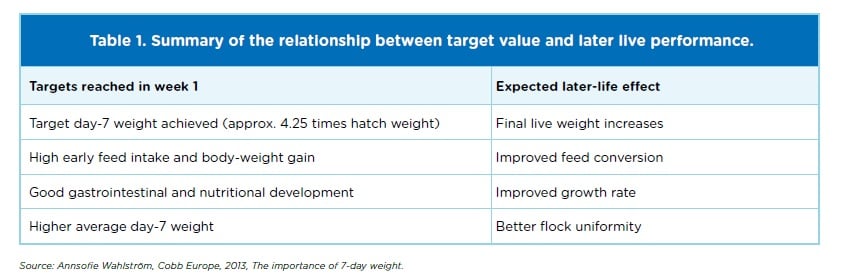
See Table 1.
For broilers, achieving a high body weight (≥ 200 g) on day 7 is essential. A higher body weight on day 7 is directly linked to higher body weight at slaughter and improved feed conversion ratio (FCR). As a rule of thumb, each additional gram of body weight on day 7 can increase weight at day 37 by 5-6 g. Internal research shows that slaughter weight can increase by 250 g, at the same slaughter age, depending on body weight at day 7.
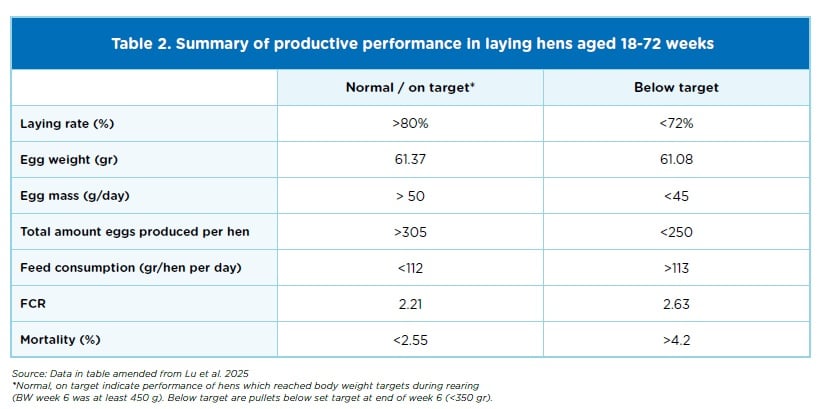
For layer pullets, a similar principle applies. Achieving target body weight early in life, particularly by the end of the brooding phase, has been shown to be a strong predictor of later performance, such as growth, egg production, and feed intake. Table 2 shows a summary of productive performance in laying hens aged 18-72 weeks, based on body weight development during the rearing period. The birds that fulfilled the recommended body-weight targets (≥450 g, week 6) had a higher laying rate and total amount of eggs produced per hen. Moreover, they were more efficient, as shown by lower FCR and higher performance with similar daily feed intake, compared to the flock below growth targets.
Moreover, body weight development during rearing is closely associated with performance milestones such as body weight at five weeks. Besides the performance parameters mentioned in the table above, body weight at five weeks is also highly correlated with laying rate, egg production and liveability.
High feed intake at a young age is important
To achieve a higher body weight on day 7, early feed intake is important. This relationship is logical from a biological perspective: early development of the gastrointestinal tract enhances nutrient digestion and absorption, allowing birds to utilise feed more efficiently later in life.
In layer pullets, early growth stimulates the development of feed intake capacity and energy reserves, which are essential for achieving target body weight at five weeks and supporting future egg production. As the gastrointestinal tract develops during the first three weeks, every gram of feed counts in these first couple of weeks. The priority must therefore be to stimulate early feed consumption.
How to increase feed intake
An optimal feed structure is key to stimulating maximum feed intake. As described by Aviagen among others, higher feed intake is achieved when feeding a high-quality crumble or pellet compared to mash. It is also a fact that high levels of fines (<1 mm) have a negative impact on feed intake, body weight and FCR. According to Aviagen data, reducing fines in feed increases body weight by up to 10% and improves FCR.
As every gramme counts, precise nutrition is key. The need for digestible amino acids is high and influences early development. Aviagen nutrition trials from 2024, showed that improved performance was obtained with higher balanced protein relative to energy, rather than simply increasing energy density of early starter feed. The trial confirmed what Koudijs Galdus Pre-Starter also shows both in trial and practice; higher digestible and balanced amino acids, combined with adjusted level metabolizable energy, results in the highest feed intake and body weights in the first week of life for broilers and the first two weeks for layer pullets.
A good start is a golden finish
For both broilers and layer pullets, achieving a high body weight on day 7, and in week 2-5, ensures high and efficient production later in life. Investing in excellent early life management and nutrition is therefore among the most effective strategies to improve productivity, efficiency, and profitability in both broiler and layer production.
About the author

Maria Saras-Johansson
Specialist Poultry
Do you have any questions or would you like more information? Get in touch with Maria.